Timeline chronicles

4.6 Billion Years of History
Welcome to the great archive of time.

This timeline is more than a simple list of dates. It is the definitive chronicle of life itself. We will trace the epic journey from the very first cells dividing in toxic, primordial oceans to the titanic beasts that shook the continents. We will also witness the catastrophic mass extinctions that routinely wiped the evolutionary slate clean, forcing the world to reinvent itself from the ashes.


The Precambrian Eon (The Dawn of the World)

This is the longest and most enigmatic chapter in Earth's history. The Precambrian spans nearly 88% of our planet's entire existence. It documents the violent transition from a glowing sphere of molten rock into a stable water world capable of harboring life.

Precambrian 88%
La Costa degli Stromatoliti

Hadean (4.6 - 4.0 billion years ago)

The Primordial Hell

During the Hadean, Earth was a colossal magma forge. Meteorites and comets relentlessly bombarded the young planet. Amidst this cosmic chaos, a Mars-sized object slammed into Earth — a colossal impact that forged our Moon. Toward the end of this eon, the planetary crust finally began to cool. Water vapor condensed into rain, filling the very first, scalding oceans.

Archean (4.0 - 2.5 billion years ago)

The Spark of Life

As the crust stabilized and the oceans settled, the most consequential event in Earth's history occurred: the emergence of life. The earliest ecosystems were dominated by simple, single-celled organisms called prokaryotes. Over millions of years, these microscopic pioneers constructed massive, layered reef structures known as stromatolites, leaving behind the very first fossil evidence of life on Earth.

Proterozoic (2.5 billion - 541 million years ago)

The Breath of the Planet

This eon unleashed sweeping atmospheric and biological revolutions. Marine cyanobacteria triggered the Great Oxygenation Event, permanently altering the atmosphere by flooding it with the oxygen we rely on today. As the first complex multicellular organisms emerged, the shifting climate triggered intense glaciations. The planet froze over almost entirely, spending millions of years as a colossal Snowball Earth.


The Explosion and the Conquest

The Paleozoic is the era of "Ancient Life." This stretch of deep time saw unprecedented biological revolutions. Life finally breached the ocean's surface and marched onto barren land. Over millions of years, pioneering plants and animals transformed sterile rocks into lush, humming forests.

Paleozoic 6.3%
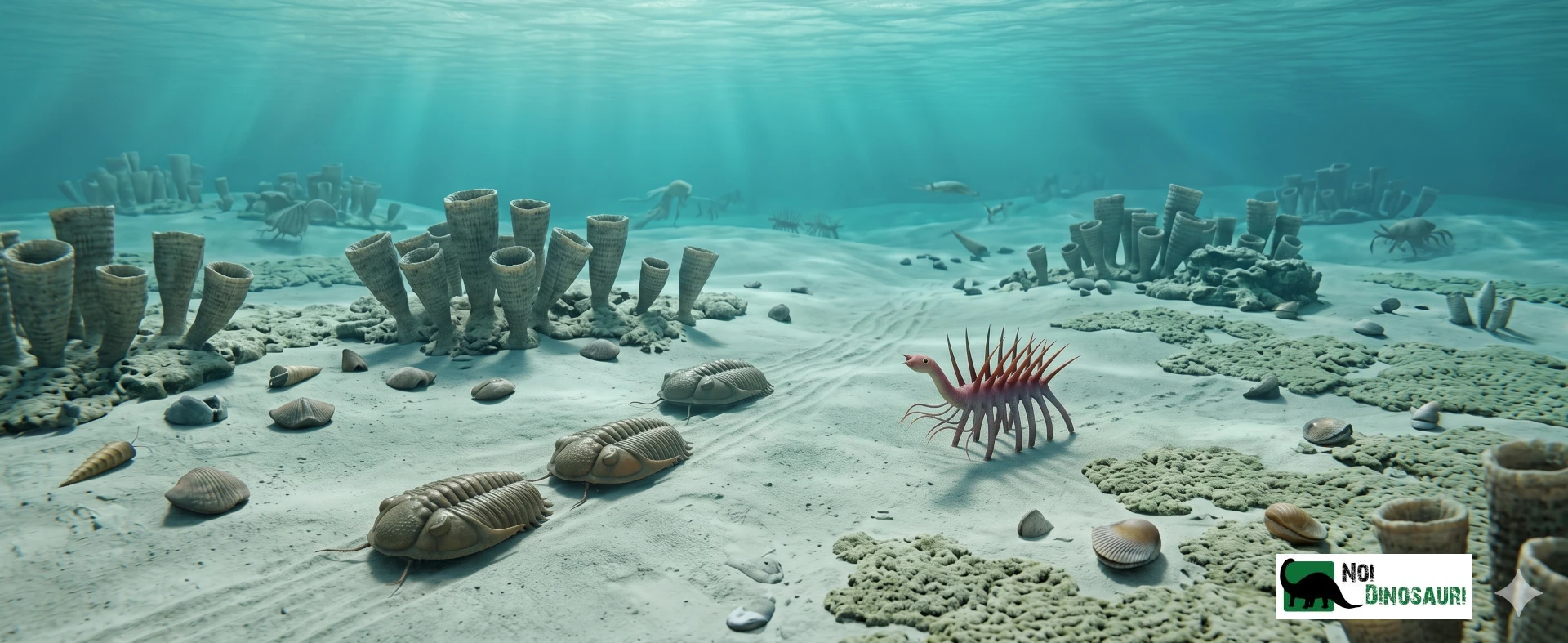
L'Esplosione Cambriana

Cambrian (541 - 485 million years ago)

The Biodiversity Explosion

The Cambrian Explosion was an evolutionary leap without parallel. For the first time, complex marine animals equipped with hard shells, jointed armor, and compound eyes appeared in the fossil record. This was the golden age of the iconic Trilobites. It also saw the rise of Earth's first true apex predators, like the fearsome, grasping Anomalocaris.

Ordovician (485 - 444 million years ago)

The First Masters of the Seas

Marine ecosystems diversified wildly. The ocean floor belonged to predatory cephalopods boasting gigantic, cone-shaped shells. Meanwhile, a major evolutionary milestone unfolded in the background: the appearance of the very first vertebrates. These were primitive, jawless fishes known as agnathans, heavily armored to survive in a predator-filled sea.

The colossal supercontinent Gondwana drifted over the South Pole. This triggered a massive glaciation event that locked up the world's water as ice. Shallow continental seas drained, and global temperatures plummeted. This sudden environmental collapse wiped out 85% of all marine species.

Silurian and Devonian (444 - 359 million years ago)

The Age of Pisces and the First Steps

Paleontologists often call the Devonian the "Age of Fishes". Heavily armored placoderms, like the school-bus-sized apex predator Dunkleosteus, ruled the waters. On land, the first vascular plants engineered true terrestrial ecosystems. Soon after, pioneer vertebrates known as tetrapods hauled themselves out of the water, breathing air and taking their first clumsy steps on the muddy shores.

A prolonged, multi-pulse biological crisis devastated the planet. Severe oceanic anoxia — a lethal depletion of oxygen in the water — choked the shallow seas. This catastrophic event collapsed vast global reef systems and consigned the great armored fishes to extinction.

Carboniferous (359 - 299 million years ago)

The Realm of Giants and Forests

A prolonged, multi-pulse biological crisis devastated the planet. Severe oceanic anoxia — a lethal depletion of oxygen in the water — choked the shallow seas. This catastrophic event collapsed vast global reef systems and consigned the great armored fishes to extinction.

Permian (299 - 252 million years ago)

The Desert of Pangea and the End of a World

The world's continents fused together to form a single, massive supercontinent: Pangea. This vast landmass created extreme, arid inland deserts. Mammal-like reptiles called synapsids dominated these harsh plains. The most famous among them was Dimetrodon, instantly recognizable by the spectacular sail-like structure on its back.

This was the closest life on Earth ever came to total annihilation. Unimaginable volcanic eruptions — known as the Siberian Traps — ignited vast coal beds and pumped toxic gases into the atmosphere, triggering a runaway greenhouse effect and catastrophically acidic oceans. A staggering 96% of marine species and 70% of terrestrial vertebrates were erased forever.


Mesozoic Era (The Age of Giants)

The Mesozoic is the era of "Middle Life". Spanning 186 million years, this is the most iconic chapter in Earth's history. Reptiles attained titanic proportions and seized control of every major ecosystem on the planet. This is the undisputed kingdom of the dinosaurs.

Mesozoic 4.0%
Il Tramonto dei Sauropodi

Triassic (252 - 201 million years ago)

The Slow Rebirth and the Pioneers

Earth remained locked in the grip of Pangea, but the landscape was a battered wasteland still recovering from the Great Dying. Life slowly clawed its way back. The first agile, bipedal dinosaurs evolved. In the skies, the leathery-winged Pterosaurs took flight. Operating entirely in the shadows of these larger reptiles, the very first shrew-like mammals made their tentative entrance onto the evolutionary stage.

Massive tectonic forces began ripping Pangea apart. The resulting volcanic rifts triggered lethal global climate shifts. Many archaic reptiles and giant amphibians succumbed to the rapid environmental changes. Their disappearance cleared the ecological stage, granting dinosaurs absolute dominance over the land.

Jurassic (201 - 145 million years ago)

The Golden Age of Behemoths

As Pangea split into Laurasia and Gondwana, oceanic moisture finally penetrated the arid interiors, blanketing the continents in lush conifer forests and giant ferns. This was the epoch of the Sauropods — titanic, long-necked plant-eaters like Diplodocus and Brachiosaurus — constantly stalked by apex predators like Allosaurus. Above them, Archaeopteryx fluttered through the canopy, representing the vital evolutionary bridge between dinosaurs and modern birds.

Cretaceous (145 - 66 million years ago)

The Evolutionary Apex and the Fall

Continents drifted closer to their modern positions. A quiet but profound botanical revolution unfolded: the explosive spread of angiosperms, or flowering plants. Herbivorous giants like the horned Triceratops and heavily armored Ankylosaurus roamed the forests. The absolute pinnacle of terrestrial predators, Tyrannosaurus rex, reigned supreme. In the warm, shallow seas, colossal marine reptiles called Mosasaurs dominated the food chain.

Cosmic catastrophe struck 66 million years ago. A 10-kilometer-wide asteroid slammed into the Chicxulub peninsula in modern-day Mexico. The impact threw a massive debris cloud into the atmosphere, plunging the planet into a deadly global winter. Compounded by massive volcanic eruptions from the Deccan Traps in India, the event wiped out all non-avian dinosaurs, pterosaurs, and giant marine reptiles.


Cenozoic Era (The Rise of Mammals and the Modern World)

The Cenozoic is the era of "New Life". Out of the smoldering ashes of the asteroid impact, small, warm-blooded survivors stepped out of the shadows to claim a world emptied of its giants. Over millions of years, the climate cooled, the continents settled into their familiar shapes, and life prepared for its most extraordinary revolution yet: human intelligence.

Cenozoic 1.4%
La Savana del Miocene

Paleogene and Neogene (66 - 2.5 million years ago)

The Legacy of the Survivors

With the giant reptiles gone, mammals underwent a rapid and explosive adaptive radiation. They evolved from tiny nocturnal insectivores into the undisputed masters of every ecosystem. Massive terrestrial herbivores, primordial whales, and towering, flightless "terror birds" all emerged in succession. Continents collided, thrusting up the Alps and the Himalayas. Dense jungles retreated, giving way to sprawling grass savannas — the precise environments that drove the evolution of the first upright hominids.

Quaternary (2.5 million years ago - Present)

The Big Freeze and the Dawn of Man

This epoch is defined by the extreme climate swings of the great Ice Ages. Immense glacial sheets repeatedly advanced and retreated, carving the modern landscapes we recognize today. This was the realm of the Pleistocene Megafauna: vast herds of woolly mammoths and mastodons navigating the frozen tundra, stalked by terrifying predators like the saber-toothed Smilodon. Amidst this perpetual struggle for survival, the genus Homo mastered fire, developed language, and marched outward to colonize the globe.

As the last glaciers melted, rapid climate upheaval collided with a lethal new variable: human hunters. According to the Overkill Hypothesis, the expansion of sophisticated human hunting groups pushed already stressed animal populations over the edge. The great prehistoric beasts vanished from the continents, leaving the planet in the hands of Homo sapiens.

La Savana del Miocene
Il triangolo Terra-Luna-Sole