
 IT
IT  DE
DE  FR
FR  ES
ES  PT
PT 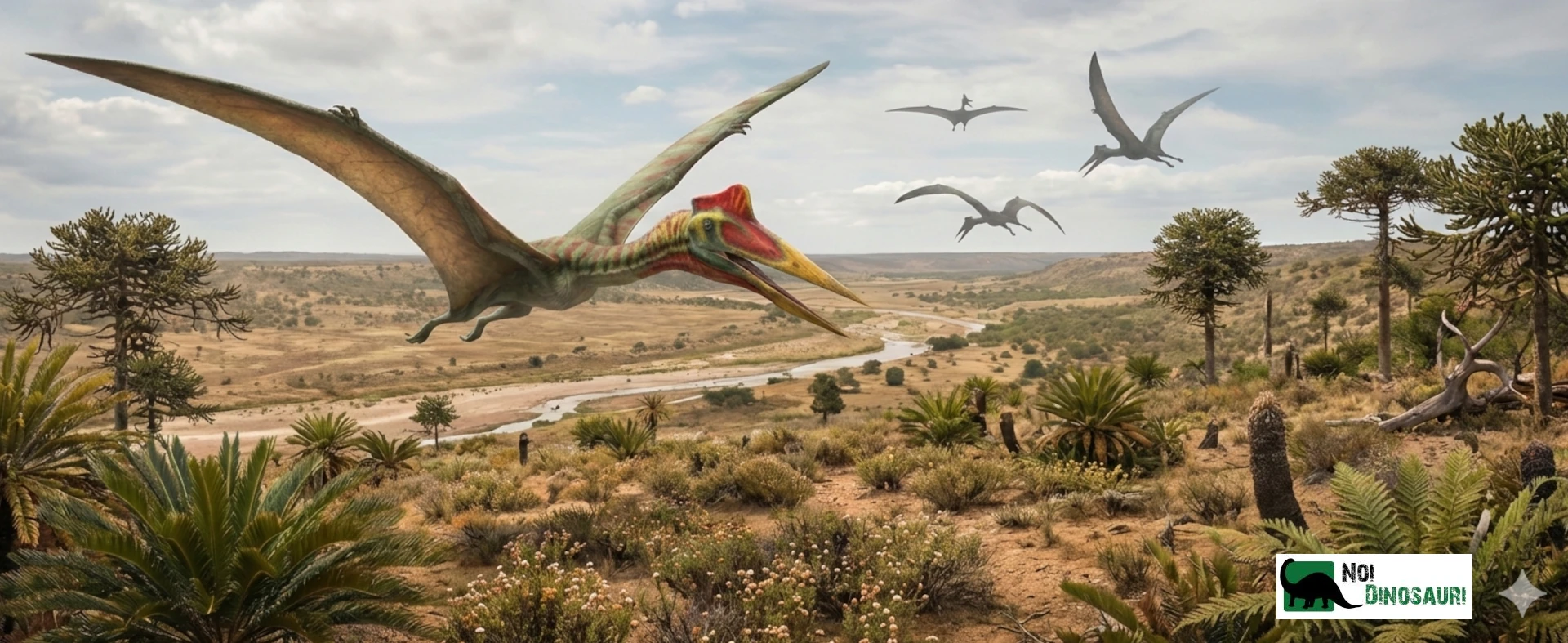
Quetzalcoatlus
The Quetzalcoatlus (Quetzalcoatlus northropi) is undeniably one of the most awe-inspiring giants to ever rule the skies. Imagine an animal as tall as a modern giraffe but possessing the miraculous ability to fly—a true masterpiece of evolutionary engineering. Belonging to the Azhdarchidae family of pterosaurs, it lived at the very end of the Late Cretaceous (roughly 68 to 66 million years ago). Although it shared its world with the dinosaurs right up until the great mass extinction, it was a prehistoric flying reptile, not a dinosaur itself. It stands tall as the largest flying animal ever to appear on Earth.
Quetzalcoatlus: History, Characteristics, and Facts
The discovery of this titan in the 1970s shattered previous scientific assumptions about the physical limits of animal flight. Geology student Douglas A. Lawson unearthed the first fossil in 1971 inside Big Bend National Park, Texas. Mesmerized by the enormous tubular bones, Lawson officially named the creature in 1975.
The name is a brilliant double tribute: Quetzalcoatlus honors the Mesoamerican "feathered serpent" deity Quetzalcoatl, while northropi nods to John K. Northrop, an aviation pioneer and creator of the flying wing aircraft. Today, these priceless remains are carefully preserved at the Texas Memorial Museum (University of Texas at Austin), where scientists continue to decode its complex biomechanics.
The anatomy of Quetzalcoatlus was relentlessly optimized to support an immense body with the absolute minimum weight possible.
Skull & Beak
Disproportionately enormous, equipped with a long, sharply pointed, and toothless beak. Supported by a stiff, elongated neck made of massive cervical vertebrae and adorned with a bony crest.
Wings
Made of a highly resilient, complex membrane of skin, muscle, and keratin fibers (actinofibrils) stretched from the body to a hyper-developed fourth finger. They were not made of feathers.
Body Covering
Covered in pycnofibers (thin, flexible fuzz resembling hair). This coating was essential for thermoregulation, strongly indicating it was warm-blooded.
Vision & Color
Acute vision for spotting hidden prey from high altitudes. It likely utilized countershading (lighter belly, darker back) for camouflage, while its head crest and beak might have flashed vibrant red, yellow, or orange for courtship displays.
Popular media often exaggerates its size, sometimes claiming a wingspan approaching 20 meters. However, the scientific reality is perfectly well-defined and still utterly staggering.
- Wingspan: Measured a massive 10 to 11 meters, rivaling a Cessna 172 light aircraft.
- Height: When standing on the ground on all fours, its shoulder height approached 3 meters. With its neck fully erect, it reached nearly 5 meters—capable of looking a modern giraffe straight in the eye.
Weight: Once thought to be an ultra-light creature of merely 70 kg, modern biomechanical studies place its mass at a much more robust 200 to 250 kg. It was a powerful, formidable predator.
Forget the old theories depicting it as an obligate scavenger or a skimming fisherman. Quetzalcoatlus was a colossal "terrestrial stalker." It patrolled the floodplains on foot, acting much like a giant marabou stork. Using its towering height to peer over shrubs and grasses, it was always ready to snatch up and swallow whole small dinosaurs, primitive mammals, lizards, and amphibians.
It ruled the skies of the island paleocontinent of Laramidia (modern-day southwestern North America). Its habitat featured warm, humid floodplains, semi-arid environments, and riparian forests. The flora of the Maastrichtian age was in full transition, with vast expanses of ferns and conifers gradually making way for early flowering plants (angiosperms).
On the ground, it shared its territory with a spectacular megafauna, including the immense sauropod Alamosaurus, herds of Bravoceratops, and hadrosaurs like Edmontosaurus. Yet, despite its towering size, it had to constantly stay clear of the apex terrestrial predator of its time: the Tyrannosaurus rex.
Curiosity - Did you know?
Taking off for a Quetzalcoatlus meant defying gravity with an incredible quadrupedal launch. Weighing over 200 kg, this pterosaur could never have taken off by simply running on its hind legs like a modern bird; they simply couldn't generate the necessary thrust. Instead, it used the immensely powerful muscles of its arms and shoulders to vault itself into the air—a leaping technique similar to a modern vampire bat or a pole vaulter. With a single, explosive contraction of its forelimbs, it catapulted itself about two meters straight up before unfurling its immense wings to slice through the Cretaceous air!