
 IT
IT  DE
DE  FR
FR  ES
ES  PT
PT 
Mosasaurus
Despite popular belief, Mosasaurus is not a dinosaur. This colossal marine reptile belongs to the order Squamata, placing it in the same evolutionary lineage as modern monitor lizards and snakes. Paleontologists still actively debate the exact nature of these deep evolutionary relationships. What remains undisputed is its dominance. During the Late Cretaceous—specifically the Maastrichtian stage, 72 to 66 million years ago—this apex predator ruled the world's oceans. It claimed absolute supremacy over the seas right before the K-Pg mass extinction wiped its kingdom away forever.
Mosasaurus: Curriculum Vitae of the species
The discovery of Mosasaurus fossils triggered a revolution in paleontology. It gave humanity its first tangible proof of extinction. Historical records point to an initial find in 1764 inside a chalk quarry near Maastricht, Netherlands, though this early specimen remains poorly documented. The real breakthrough occurred with a second skull uncovered in 1778, followed by a spectacularly preserved third skull in 1780. Both surfaced along the banks of the Meuse river. This location directly inspired the creature's name: Mosasaurus translates to "lizard of the Meuse."
These ancient remains immediately captivated Europe's greatest scientific minds. Dutch naturalist Martinus van Marum and geologist Adriaan Camper conducted early examinations. However, the legendary French naturalist Georges Cuvier delivered the definitive systematic analysis in 1808. Wielding immense scientific authority, Cuvier proved that massive, entirely vanished creatures had once roamed the Earth.
The most famous skull boasts a history that reads like a thriller. When French troops occupied Maastricht in 1795, they actively requisitioned the celebrated fossil to relocate it to Paris. Legend claims the original owner desperately tried to hide it, but soldiers tracked the prize down—allegedly trading six hundred bottles of wine for its surrender. Today, the Muséum national d'Histoire naturelle in Paris safely houses this spectacular original specimen.
The Leviathan with the Snap-Trap
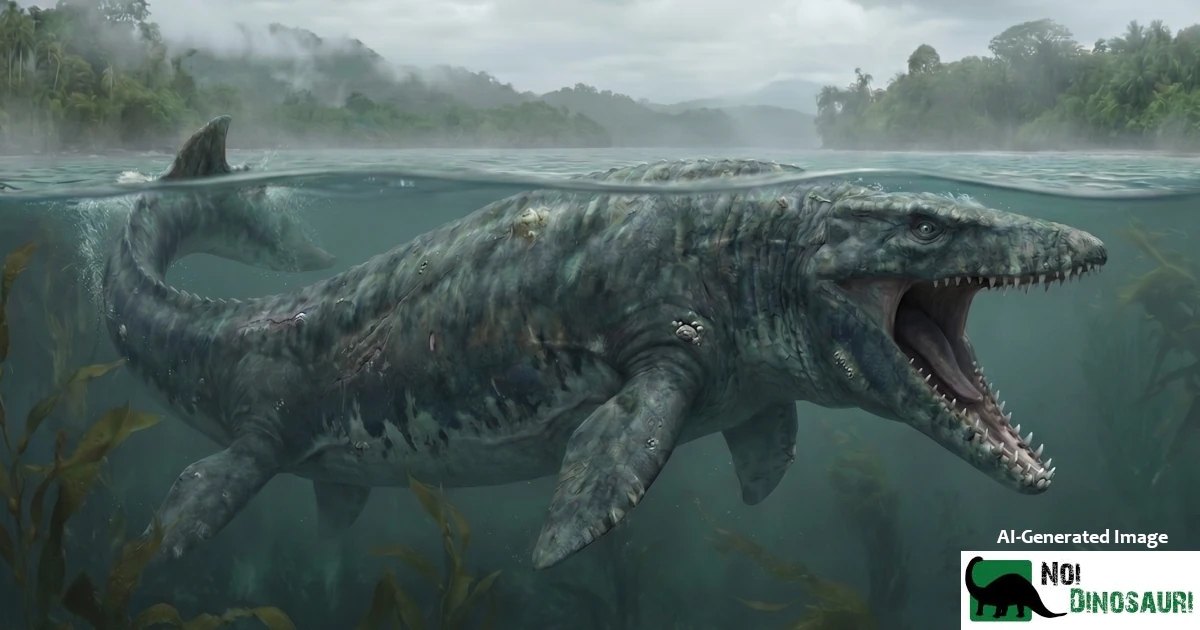
Do not look for an escape route. Once those jaws close, you're already swallowed. This predator did not just bite; it locked its prey in a lethal trap using curved pterygoid teeth hidden on its palate. This second row of hooks on the roof of the mouth functioned exactly like the safety lock on a climbing carabiner. Stretching up to 13 meters long, this highly derived possessed jaws that were entirely unsuited for chewing. Instead, they operated as an unstoppable conveyor belt, ratcheting live, whole prey directly down the esophagus.
To perfect this grisly mechanism, the skull evolved highly flexible kinetic joints. This double-hinged structure enabled the animal to expand its jaws to monstrous proportions. Once the primary teeth snared a victim, escape became impossible. The palate teeth "walked" forward, mechanically forcing the prey down the throat. This highly efficient, as macabre as it is mercilessly efficient mirrors the feeding mechanics of modern constrictor snakes.
Kevlar Scales and Shadow Cloaks
Running a hand along a mosasaur's flank would feel like touching the rough, woven texture of bulletproof Kevlar. It completely lacked the smooth, rubbery skin of a dolphin. Instead, tiny keeled scales armored its body, specifically adapted to slice through water and drastically reduce hydrodynamic drag. Its coloration functioned as a masterpiece of optical illusion. Relying on countershading, it sported a slate-dark back and a chalk-white belly—a camouflage strategy identical to a modern attack submarine. We know it lacked vibrant display structures thanks to exceptionally preserved fossil scales containing melanosomes, the microscopic cellular capsules that hold original pigment. From above, the predator vanished into the abyssal depths; from below, it dissolved into the sunlit surface.
The Caudal Propulsion Torpedo
Forget the outdated depictions of a sea serpent undulating lazily through the waves. This animal operated as a highly engineered hydrodynamic missile. It did not rely on its four limbs for propulsion; over millions of years, these had evolved into rigid, directional flippers. Instead, a massive, bilobed tail generated its explosive thrust. Paleontologists identified a sharp, unnatural downward bend in the final caudal vertebrae of perfectly intact fossils. This skeletal deviation anchored the framework of a giant, fleshy upper fin, creating the ultimate biological engine for blistering acceleration and lightning-fast ambushes.
The Armored Nutcracker
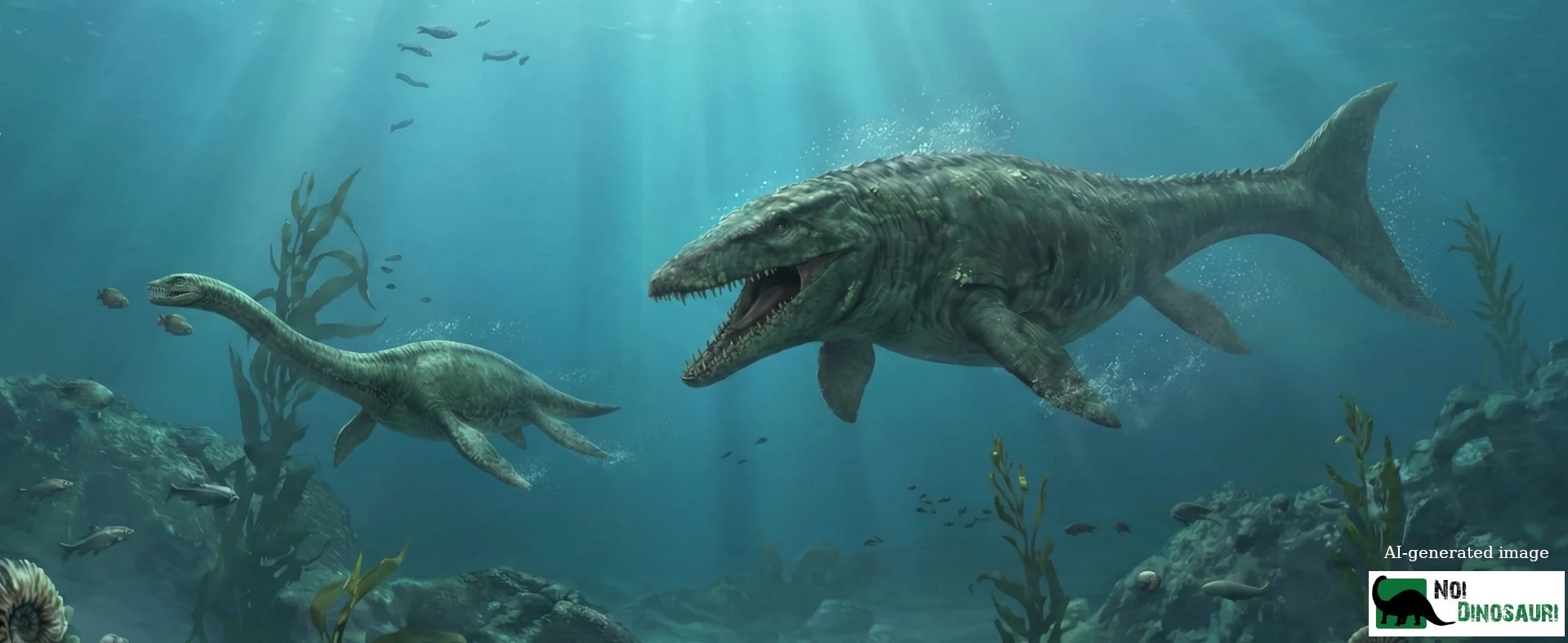
Mosasaurus sat uncontested at the absolute pinnacle of the oceanic food chain. It regularly hunted sharks, sea turtles, and even smaller mosasaurs. Occasional targets included long-necked plesiosaurs like the elasmosaurids. Imagining a mosasaur ambushing an elasmosaur in open water perfectly captures the sheer brutality of the Cretaceous marine ecosystem. Its mouth functioned as a hydraulic vice explicitly calibrated to crush shell and bone. Paleontologists have unearthed countless ammonite fossils riddled with devastating, circular puncture wounds. Superimposing mosasaur tooth casts over these ancient injuries reveals a surgical, millimeter-perfect alignment.
The true measurements of Mosasaurus radically diverge from the titanic, oversized monsters popularized by Hollywood. In scientific reality, the type species Mosasaurus hoffmannii stands as one of the largest squamates in Earth's history. It reached an estimated maximum length of 12 to 13 meters, with a body weight fluctuating between 8 and 14 tons. It did not need exaggerated movie proportions to dominate its ecosystem. Encountering a predator the size of a city bus, armed with a skull over 1.5 meters long, meant one terrifying thing: this animal was built to kill.
Ecologically, Mosasaurus operated as a highly adaptable generalist macropredator. It predominantly patrolled the vast Tethys Sea and the newly formed Atlantic Ocean. Its preferred hunting grounds were warm, clear, and relatively shallow epicontinental seas teeming with rudist reefs. In these vibrant waters, it shared the ecosystem with colossal sea turtles like Allopleuron and toothed, diving birds like Hesperornis.
Crucially, recent biochemical studies suggest these enormous marine reptiles were partially mesothermic. They could generate and maintain a body temperature slightly above that of their surrounding environment. This active metabolism allowed them to sustain prolonged, high-speed hunts in open water, making their physiology more comparable to a great white shark than to a cold-blooded terrestrial lizard.
Reproduction
Unlike sea turtles or most modern terrestrial reptiles, Mosasaurus never dragged itself onto a beach to lay eggs. It was entirely viviparous. Females gave birth to live young directly into the treacherous open ocean. Rare, exquisitely preserved fossils have actually revealed the delicate bones of unborn juveniles still nestled inside the mother's abdominal cavity. This specialized reproductive strategy underscores just how profoundly Mosasaurus had adapted to an exclusive, lifelong marine existence.
The Extinction
The reign of Mosasaurus spanned roughly six million years. Then, 66 million years ago, a ten-kilometer asteroid slammed into the Yucatán peninsula. The apocalyptic impact unleashed global wildfires and choked the atmosphere with debris, blocking out the sun for years. Temperatures plummeted, triggering a top-down collapse of global food chains. As oceanic phytoplankton died off, the marine ecosystem starved. Sitting at the very apex of the pyramid, Mosasaurus found itself with nothing to eat. It perished alongside the non-avian dinosaurs and plesiosaurs during the Cretaceous-Paleogene mass extinction event. The seas would not witness a predator of such terrifying, total dominance for millions of years. It remained a master predator, right to the bitter end.
Curiosity - Did you know?
The skull of Mosasaurus featured a double-hinged cranium — kinetic joints that allowed it to expand its jaws far beyond what you would expect from an animal of that size. Combined with the pterygoid teeth lining the palate, which functioned as a second row of hooks, swallowing became an inexorable mechanical process: prey was snagged, driven forward, and funneled toward the esophagus in an unbroken sequence of movements that left absolutely no possibility of escape. This same principle is visible today in constrictor snakes — yet another testament to the deep evolutionary kinship between these two seemingly unrelated animals.
Yes. Its skull possessed highly specialized kinetic joints. This double-hinged structure allowed the animal to expand its jaws vastly beyond what is typically expected for a creature of its size, enabling it to swallow massive prey whole.
Mosasaurus possessed pterygoid teeth located on the roof of its mouth. These operated as a second, hidden row of hooks. Once prey was caught, these teeth mechanically "walked" the victim down the esophagus, making escape practically impossible.