
 IT
IT  DE
DE  FR
FR  ES
ES  PT
PT 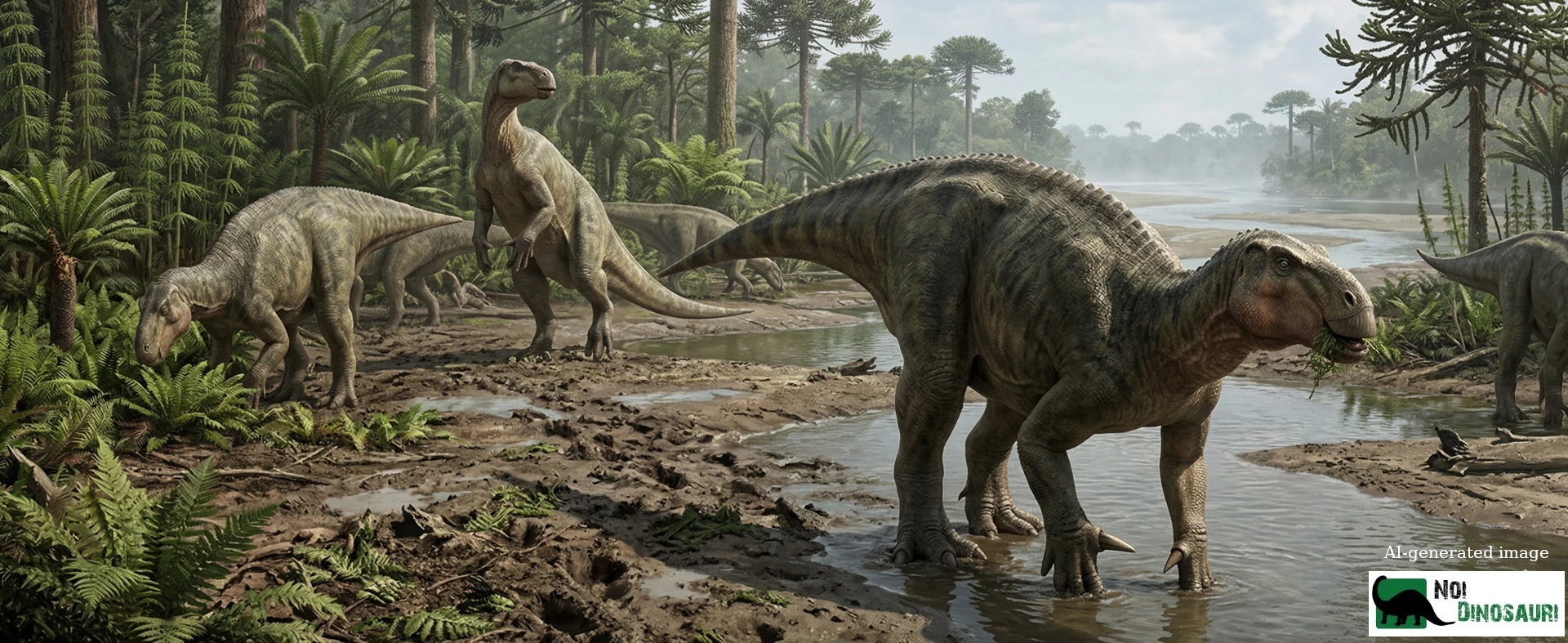
Iguanodon bernissartensis
Iguanodon (Iguanodon bernissartensis) was a massive herbivore belonging to the styracosternan ornithopod group that lived at the dawn of the Early Cretaceous, roughly 126 to 122 million years ago. Famous for being only the second dinosaur ever named by science, this European giant stood out thanks to a remarkable biomechanical trait: it fluidly shifted between a bipedal and a quadrupedal stance. Long before the great duck-billed dinosaurs arrived on the scene, Iguanodon ruled the prehistoric landscape.
Iguanodon bernissartensis: History, Characteristics, and Facts
Iguanodon represents a true milestone in the history of paleontology. English physician Gideon Mantell first described the animal at the height of the Victorian era in 1825. Its name literally translates to "iguana tooth." Mantell noticed that the very first fossils, unearthed in Sussex, England, perfectly matched the teeth of modern Central American iguanas—except they were scaled up to monstrous proportions.
The real revolution in our understanding of this creature, however, happened decades later. In 1878, deep inside a Belgian coal mine in Bernissart, miners stumbled upon a spectacular fossil deposit. This subterranean treasure trove contained over thirty complete, perfectly articulated skeletons. Today, these magnificent original specimens stand as a silent phalanx at the Royal Belgian Institute of Natural Sciences in Brussels, forming one of the world's most breathtaking bone beds ever displayed.
The Wrist Dagger
A straight, fifteen-centimeter cone of bone, rigidly fused to the joint, served as the secret weapon of Iguanodon. The three central fingers of the hand were robust and calloused, evolving into thick hooves that supported tons of weight during prolonged grazing. The highly flexible pinky finger acted as a prehensile hook, allowing the animal to pull leafy branches directly into its mouth. The thumb, however, abandoned all grasping function. It was a pure bone awl—a natural brass knuckle. The dinosaur used this fixed thumb spike to deliver lightning-fast, devastating strikes into the flank or neck of any careless predator.
The Cretaceous Grinder
Chewing is a rare trait in the reptile world, but this herbivore elevated it to an engineering art form. Broad fleshy cheeks concealed tightly packed dental batteries that operated like a relentless industrial shredder. Microscopic wear analysis on fossilized teeth reveals a highly developed cranial mechanism known as pleurokinesis. As the jaw closed, the skull bones elastically bowed outward, forcing the upper teeth to grind across the lower ones in a powerful transverse motion. This uncompromising system pulverized the toughest plant fibers, giving Iguanodon an almost unmatched evolutionary advantage.
A Shapeshifting Colossus
The build of this creature was a perfect hybrid, acting like a heavily armored vehicle capable of shifting gears on the fly. While resting or grazing, the animal planted itself on four legs with the ironclad stability of an endurance walker. When threatened, it agilely reared up on powerful hind legs, balancing its weight with a stiff, massive tail thrust backward. As the animal aged, the tendons along its spine progressively calcified through tendon ossification. These tendons transformed into structural reinforcing bars that locked the spine in place, preventing it from collapsing under the dinosaur's monumental weight.
Strength in Numbers
This giant rarely wandered alone. The ground would literally vibrate beneath thousands of tons of synchronized muscle, while the pungent scent of turned earth and crushed ferns filled the humid air. The true strength of the species lay in the herd—an impenetrable wall of bodies. The discovery of vast collective graveyards across Europe definitively proves that these dinosaurs lived, migrated, and died in complex social groups. They formed a united front that forced even the most formidable carnivorous theropods to calculate every single move before launching an attack.
Early paleontologists heavily misrepresented the proportions of Iguanodon. Victorian scientists initially reconstructed it as a monstrous, squat, crawling lizard. Mid-twentieth-century museums then overcorrected, depicting it in a perpetual, upright stance like a gigantic kangaroo resting on its tail. Today, backed by 3D scans and rigorous biomechanical models, modern paleontology reveals a towering, horizontally balanced, and fluidly moving animal.
Large adult specimens reached nine to ten meters in length from their robust beak to the tip of their tail, weighing between four and five tons. It possessed the formidable bulk of a modern male Asian elephant, yet it moved with the unexpected agility of a facultative biped.
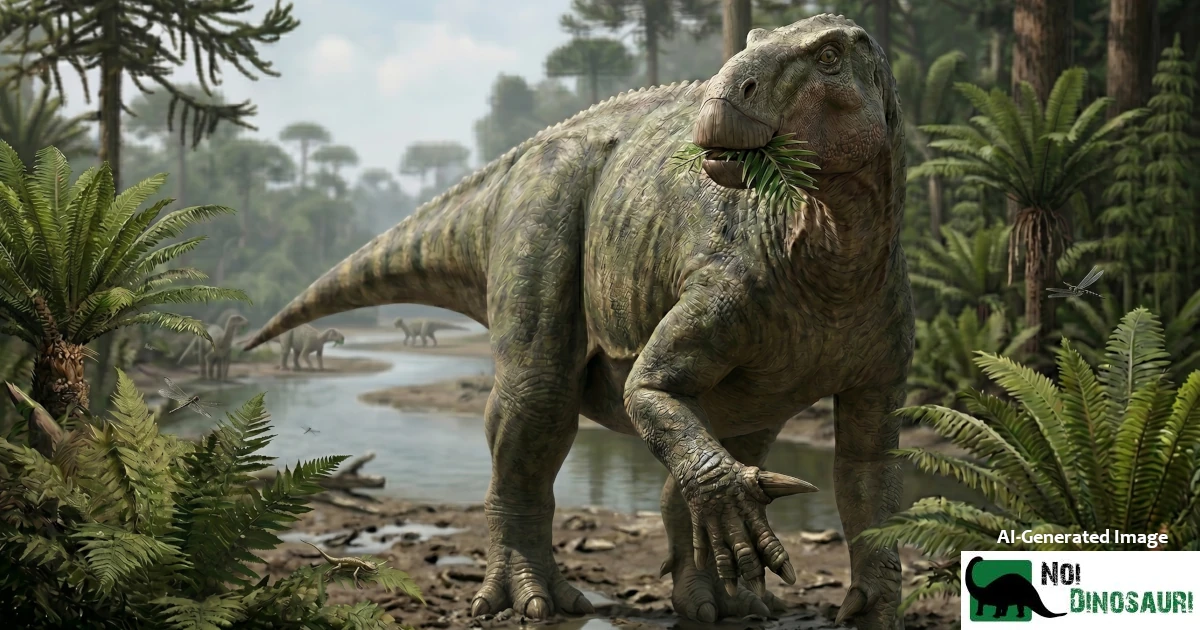
Iguanodon reigned as the undisputed ruler of the fertile European plains. It acted as an unstoppable environmental engineer, actively reshaping dense local vegetation simply by crashing through it. During the Aptian stage, Europe was not a single landmass but a vast archipelago of tropical islands bathed by warm seas, resting on the margins of the ancient northern supercontinent, Laurasia.
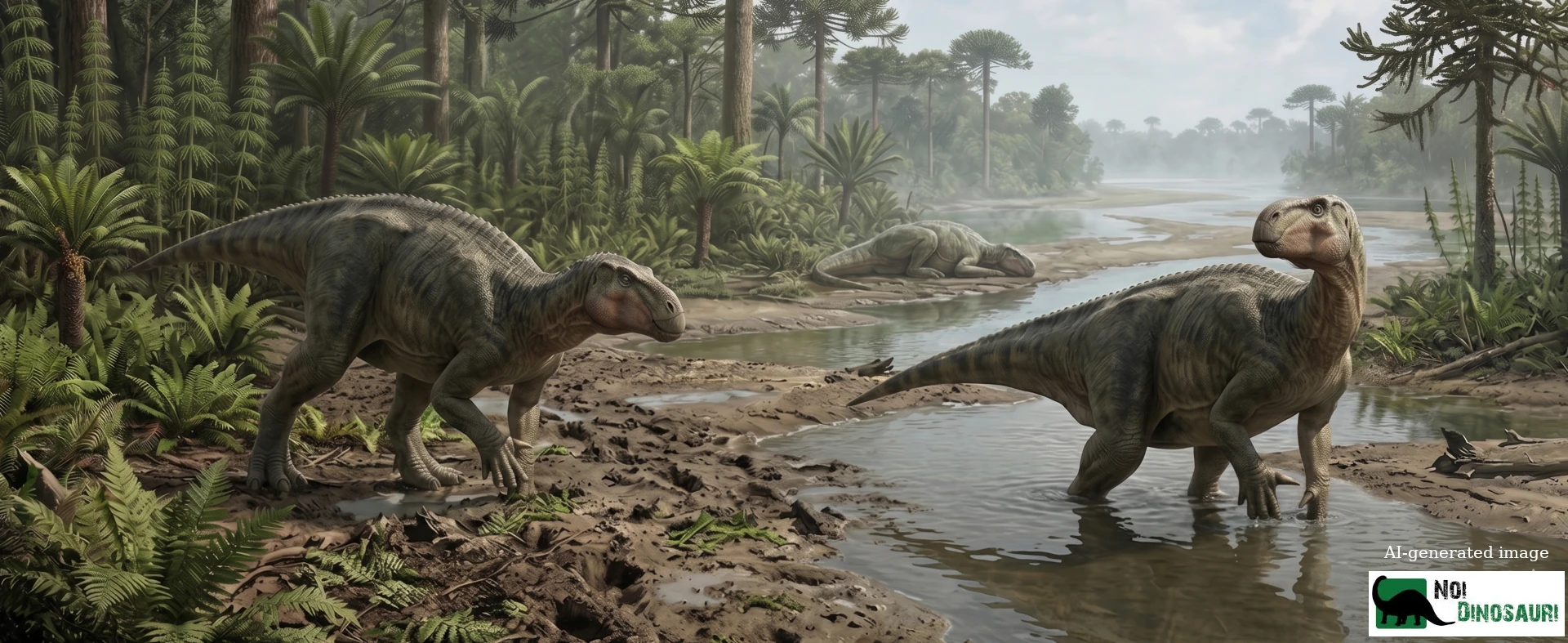
Its ecosystem consisted of broad floodplains, shifting river deltas, and shadowy forests filled with ferns, cycads, giant horsetails, and towering conifers. Using its strong keratinous beak to strip branches and its powerful jaws to extract every available calorie, the Iguanodon thrived. It shared these muddy trails with armored herbivores like Polacanthus and swift runners like Hypsilophodon.
However, the dark shadow of apex predators constantly shattered the peace. The great herds remained on perpetual high alert to fend off ambushes from agile, blade-toothed hunters like Neovenator, or colossal, crocodile-jawed fish-eaters like Baryonyx that stalked the waterways.
Reproduction
Like most ornithopod dinosaurs, Iguanodon was almost certainly oviparous, laying its eggs in terrestrial nests or large mounds built from rotting vegetation. While direct evidence of nesting remains rare, the highly gregarious behavior documented in fossil beds strongly suggests they used collective nesting grounds. Multiple adult females likely shared these large clearings, relying on the herd for community defense against egg-thieves and predators.
Hatchlings sported very different proportions than the adults, featuring significantly longer hind limbs relative to their forelimbs. This anatomical quirk indicates that juveniles were exclusively bipedal, capable of sprinting away from danger with a reactivity their adult bulk would eventually prevent. As they grew and their bulk steadily accumulated, their gait smoothly transitioned into the efficient bipedal-quadrupedal alternation seen in mature adults. Paleontologists also suspect a degree of sexual dimorphism existed within the herds, as certain skeletons appear noticeably more robust, though confidently telling males from females remains a tough challenge.
The Extinction
The disappearance of Iguanodon bernissartensis didn't stem from a fiery cosmic catastrophe, but from a much quieter, relentless process: ecological replacement. Toward the end of the Early Cretaceous, the European ecosystem underwent massive paleogeographical shifts. The Laurasian archipelago fragmented, sea levels rose, and the rapid spread of the first flowering plants (angiosperms) radically transformed the available food web.
In this shifting landscape, more advanced ornithopods—the direct ancestors of the great hadrosaurids (duck-billed dinosaurs)—proved vastly more efficient at processing these new, tough plant types. They slowly but surely invaded the ecological niches that Iguanodon had dominated for millions of years. There was no sudden collapse; just a gradual erosion of a competitive edge. Iguanodon wasn't defeated by an asteroid, but by the very force that originally forged it: relentless evolution.
Curiosity - Did you know?
The Horn That Wasn't a Horn
For over fifty years after its discovery, scientists mistakenly glued the lethal thumb spur of Iguanodon right onto its nose, making it look like a massive, scaly rhinoceros.This enduring misunderstanding — almost comical in hindsight — stemmed from the very first fragmentary fossils found in England, where an isolated conical bone logically seemed to belong on the creature's snout. The spectacular 1878 Bernissart mine discoveries finally corrected the record. That pointed bone wasn't a facial ornament at all; it was a deadly weapon located on the wrist—a built-in dagger meant to tear flesh in desperate close-quarters combat.
Dinner in the Belly of the Beast
Iguanodon sparked the world's very first dinosaur craze, long before Hollywood invented prehistoric blockbusters. In 1854, sculptor Benjamin Waterhouse Hawkins built imposing life-size concrete dinosaur models to inaugurate the Crystal Palace gardens in London. Iguanodon—still wildly inaccurate and sporting a nose-horn—was the star of the show. The night before the grand opening, Hawkins hosted a lavish gala dinner for twenty-one elite scientists entirely inside the hollow mold of the Iguanodon. They literally ate a banquet in the belly of the beast to celebrate the triumph of paleontology. You can still visit these protected historical sculptures in London today!