Triceratops

The living battleship of the Late Cretaceous

Triceratops (genus Triceratops) was an ornithischian dinosaur in the ceratopsid family. It lived between 68 and 66 million years ago during the Maastrichtian, the final phase of the Cretaceous period. A massive four-legged herbivore. The final evolutionary chapter of horned dinosaurs before the Mesozoic mass extinction. A perfect biological machine.

Scientific name
Diet

Triceratops: Curriculum Vitae of the species

History and Discovery

It starts in 1887 with a colossal paleontological error. Near Denver, Colorado, massive fossilized horns emerged. Paleontologist Othniel Charles Marsh attributed them to a gigantic prehistoric bison. The mistake lasted two years. In 1889, an intact skull revealed the truth. Marsh identified the dinosaur and coined the genus Triceratops: from Ancient Greek, "three-horned face." Today, fossils of the two valid species — Triceratops horridus and Triceratops prorsus — are displayed and studied at the Smithsonian National Museum of Natural History in Washington.

Anatomy and characteristics

The walking armory (Skull and horns)

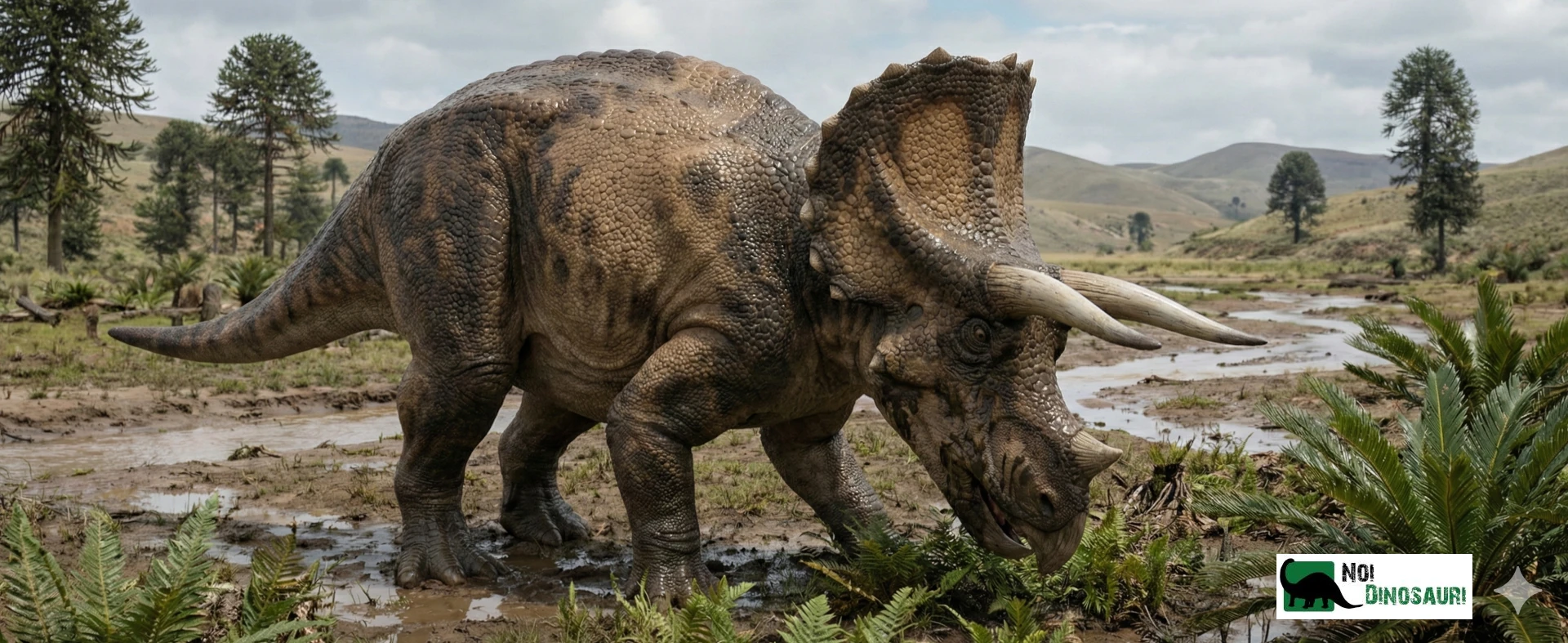
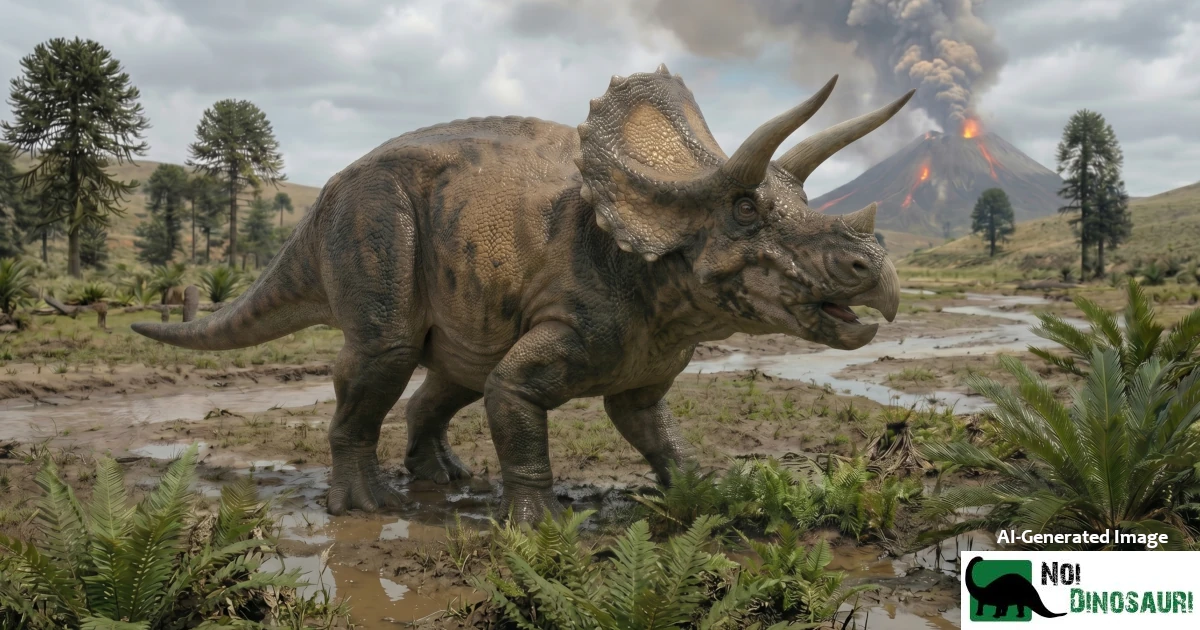
The anatomy of Triceratops relies on a cranial architecture with no equal in the animal kingdom. The skull alone exceeded 2.5 meters in length. It accounted for almost a third of the animal's total size. The frontal armament deployed two forward-pointing supraorbital horns measuring over a meter long, flanked by a short, thick nasal horn.

Behind this crown of lances rose the bony frill. Unlike other ceratopsids, this shield was a solid block of bone, devoid of openings (fenestrae). Absolute armor for the neck. An unbreakable anchor for the immense jaw muscles. To support the tons of this armored head, the forelimbs were hypertrophied and angled outward. The hindlimbs stood straight. Load-bearing columns.

The vegetarian meat-grinder (Beak and teeth)

The snout ended in a toothless keratinous beak. Identical to modern snapping turtles or large parrots. The exact tool to shear branches and tough vegetation with one bite. The actual grinding occurred in the back. The jaws concealed dental batteries composed of hundreds of teeth in continuous replacement. A mill capable of pulverizing tons of fibrous plant matter.

The secret of the "Lane" mummy (Skin and texture)

Smooth reptilian skin is an obsolete myth. Fossil mummies with exceptional preservation, like the famous "Lane" specimen, reveal the true nature of its dermal armor. Triceratops was covered in large, non-overlapping hexagonal scales. The largest scales measured several centimeters across and featured a massive conical protrusion in the center. Smaller scales surrounded them, drawing a "rosette" pattern. To the touch, the skin felt thick, rough, and knobby. A texture halfway between a basketball and the armor of an old crocodile. The tail area featured structures similar to the quill bristles of modern porcupines.

The language of colors (Camouflage and display)

The animal's body displayed camouflage tones (brown, gray, olive green). A strategy to hide 8 tons of mass in the undergrowth of ferns and conifers. The nuchal shield obeyed different rules. The surface of the frill harbored a dense network of blood vessels. It functioned as a visual display board. By pumping massive volumes of blood to the surface, the animal could flush the frill with color during courtship or moments of rage. An instant blush spread across two square meters.

Actual Size (Myth vs. Reality)

Morphometric and osteological data destroy the image of a clumsy beast. They describe a muscled, agile, and lethal giant. An adult specimen reached a maximum length of 9 meters and a hip height of 3 meters. The estimated weight ranged between 8 and 12 tons. Heavier than the largest modern African elephant. Anchored to the ground by a very low center of gravity. Unassailable. Impossible to flip over, even for the most colossal of theropods.

Diet and Paleoecology

A hyper-specialized herbivore, it dominated the ancient island continent of Laramidia, a vast strip of land forming western North America today, from Alaska to Mexico. Its ecosystem consisted of wide floodplains and humid subtropical forests. Here it fed on ferns, cycads, palms, and the first angiosperms (flowering plants).

It shared the landscape with majestic hadrosaurs like Edmontosaurus and the armored Ankylosaurus. It was the primary prey, and the lethal nemesis, of Tyrannosaurus rex. This dynamic is not narrative fiction. It is carved into bone.

Finding direct evidence of Triceratops horns in T. rex bones is rare. Biomechanics explains why. The bite of a T. rex was devastating: teeth shattered and remained wedged in the ceratopsid's bone. The horn pierces, lacerates, and is extracted. It does not break. Furthermore, the herbivore's lethal thrusts targeted the predator's soft tissues (belly, intestines, thigh muscles), areas lacking fossilization. Yet, evidence of its fatal strikes exists:

  • The "Lee Rex" case: A T. rex skeleton unearthed in Wyoming shows a deep puncture in the femur, accompanied by a slide-mark gouge. The size and shape of the wound match the tip of an adult Triceratops horn. The bone shows no sign of healing. A fatal strike. The horn severed muscles and arteries, causing the predator to collapse.
  • Shattered ribs: Dozens of adult T. rex skeletons, including the famous "Sue" at the Field Museum in Chicago, display an astonishing number of broken and healed ribs. Massive blunt-force thoracic trauma. The frontal charge of an 8-ton Triceratops carried the impact force of a speeding truck. It crushed the ribcage without even piercing it.

Tactical bites: Dental marks on ceratopsid skulls prove the Tyrannosaurus aimed for the horns or the edges of the frill. A clear tactic. The predator attempted to immobilize the frontal weapons before attacking the body. Exposing oneself to a direct charge meant getting impaled.

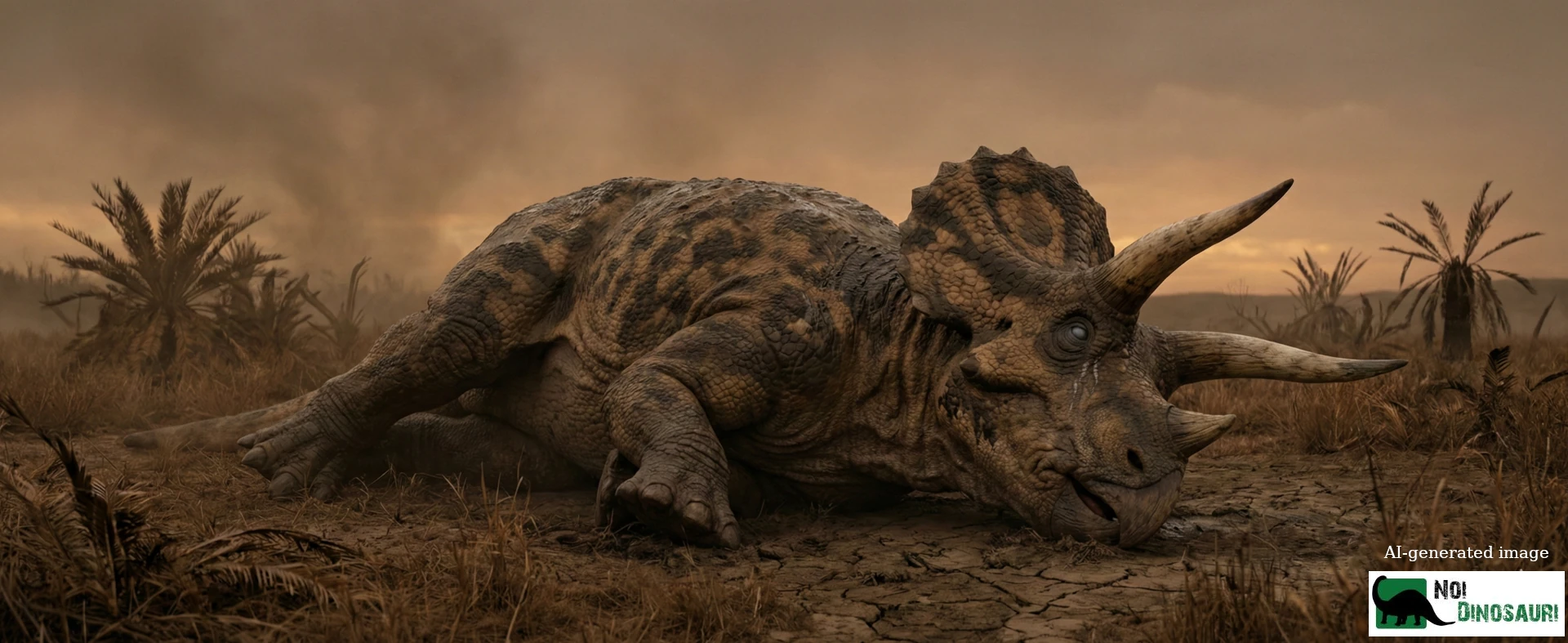
Triceratops dead after meteorite impact

Curiosity - Did you know?

Taphonomy documents scenes of extreme survival. Paleontologists recovered a Triceratops horn bearing the bite marks of a Tyrannosaurus rex. The crucial detail: the surface shows traces of bone regrowth. The herbivore survived the apex predator's assault. Furthermore, biomechanical analysis of lesions found on numerous bony frills proves the existence of fierce intraspecific combat. Triceratops locked horns in spectacular duels over territory or mating rights. Just like contemporary deer or bighorn sheep. A clash of titans.

IMPORTANT - Some statements regarding behavior, coloration, and sensory abilities reflect ongoing scientific hypotheses, not established certainties.