
 IT
IT  DE
DE  FR
FR  ES
ES  PT
PT 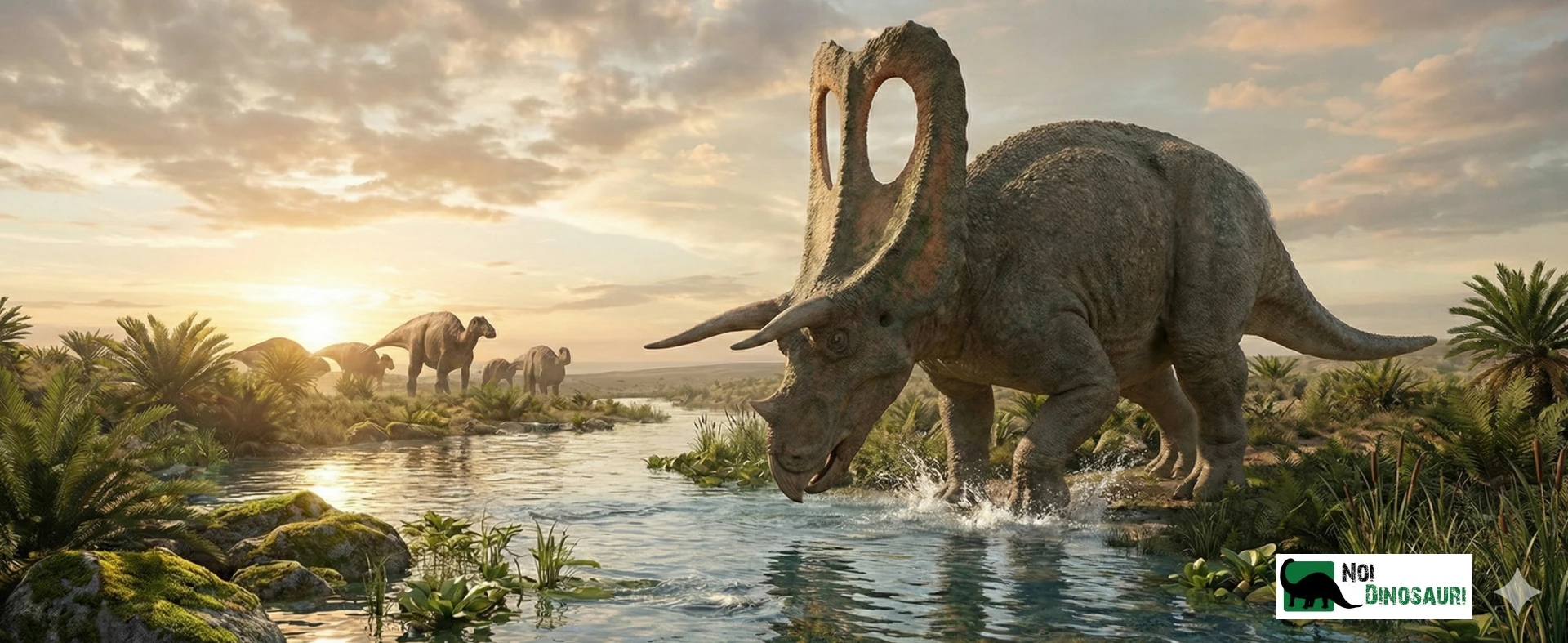
Torosaurus
Torosaurus was a massive herbivore belonging to the Ceratopsidae family. It inhabited the plains of North America at the absolute end of the Cretaceous period (Maastrichtian age), between 68 and 66 million years ago. It walked just steps away from the great mass extinction. A quadruped engineered for survival. It possessed one of the longest skulls of any known land animal.
Torosaurus: History, Characteristics, and Facts
The year 1891 marks the extraction of the first fossil fragments. The rugged badlands of Wyoming. Paleontologist John Bell Hatcher spearheaded the exploration. That same year, Othniel Charles Marsh officially described the specimen.
The etymology hides a persistent public myth. The name does not stem from the Spanish or Italian word toro (bull). It derives strictly from the Ancient Greek toreo (to pierce) and sauros (lizard). A direct anatomical reference. The "pierced lizard" bears massive bony windows (fenestrae) within its enormous frill. Today, primary skulls are archived and displayed at the Yale Peabody Museum in Connecticut and the Milwaukee Public Museum in Wisconsin.
The Pierced Shield (Skull and Frill)
The anatomy of Torosaurus is defined by a cranial scaffolding reaching nearly 3 meters in length. The footprint of a compact car. The defining feature was its sweeping nuchal frill. Unlike the solid shield of Triceratops, this bony plate featured two enormous openings. These fenestrae were covered only by taut, scaly skin. The bone surface was heavily trenched with deep vascular channels, serving a specific biological function.
Frontal Bayonets and Industrial Shears
The frontal armament consisted of two long, curved supraorbital horns positioned above the eyes, paired with a shorter nasal horn. The oral cavity hid a precision cutting tool. A sharp keratinous beak severed thick vegetation. Microscopic analysis of dental wear details the exact mechanics of its bite. Paleontologists scanning the dental batteries under electron microscopes identified perfect vertical striations. The jaws did not grind side-to-side. They snapped shut like a guillotine. A biological mechanism that self-sharpened the teeth with every single bite.
Armored Biomechanics
Supporting a head weighing hundreds of kilograms required structural perfection. The 6-ton body rested on stout, massive legs functioning as structural pilings. 3D biomechanical modeling of the joints, combined with fossil footprint analysis, confirms a semi-erect posture for the forelimbs. It did not sprawl like a crocodilian. This skeletal configuration allowed the ceratopsid to absorb massive frontal impacts and lunge with sudden agility.
The Language of Colors (Display and Communication)
The frill operated as a sophisticated visual communication array. The evidence is carved into the fossilized skulls. Deep bone canals once housed a massive network of blood vessels. During territorial disputes or courtship, Torosaurus pumped liters of blood into the taut skin stretched across the fenestrae. The surface ignited with color. A blinding visual signal. Studies on ceratopsid vascularization indicate this flush of blood was paired with low-frequency vocalizations. Deep rumbles propagating through the ground.
The extreme gigantism of the skull distorts the actual proportions of the animal. The head reached a record-breaking length of 2.77 meters. A terrestrial record challenged only by Pentaceratops and Titanoceratops. The postcranial body, however, was relatively slender.
Modern biometric studies constrain a fully grown adult to a maximum length of 7.5 to 8 meters. The estimated weight sat between 4 and 6 tons. A cyclopean beast, yet measurably lighter than Triceratops, which possessed a slightly shorter frame but a much denser, heavily muscled build.
Torosaurus inhabited the island continent of Laramidia, the landmass forming modern-day western North America. It was isolated from Appalachia by the Western Interior Seaway. The ecosystem was a mosaic of floodplains, swampy forests, and subtropical coastal zones. Operating in herds or family groups, the ceratopsid sheared through ferns, cycads, and the increasingly prevalent angiosperms (flowering plants).
The Maastrichtian environment was unforgiving. It shared grazing grounds with gigantic hadrosaurs like Edmontosaurus and the armored Ankylosaurus. The apex of the food chain was occupied by Tyrannosaurus rex. Against this superpredator, the supraorbital horns of Torosaurus provided a formidable, and strictly necessary, line of defense.
Curiosity - Did you know?
Between 2010 and 2011, paleontologists John Scannella and Jack Horner published a polarizing hypothesis. They proposed that Torosaurus never existed as a distinct genus. They argued it merely represented the advanced elderly phase of Triceratops. According to this theory, as a Triceratops aged, its solid frill thinned and eventually opened to form the characteristic fenestrae.
Subsequent osteological research dismantled this theory. Paleontologists like Nicholas Longrich and Andrew Farke — with data verified up to 2024 — proved the existence of immature Torosaurus specimens. Furthermore, they identified specific morphological differences at the base of the skull that are entirely incompatible with the maturation hypothesis. Torosaurus and Triceratops are close cousins. Distinct, separate genera. Torosaurus retains its taxonomic identity.